Walk the roundabout in Garden Hills this month and the neighborhood's centennial clock is still something to look forward to. The Garden Hills Civic Association announced a four-faced timepiece for one of the neighborhood's landscaped traffic circles as part of its 100th anniversary, a commemorative marker for a milestone year. The centennial gala took place last November at Cherokee Town Club, and the neighborhood's own updates continue to describe the clock as an installation to come.
That gap between what got announced and what's actually on the ground is the real story of Garden Hills right now. The centennial was framed as a single arc with a beginning and an end, but walk the neighborhood today and you'll find pieces of it still arriving, pieces that never showed up, and an entirely separate construction project reshaping the same sidewalks the anniversary was supposed to honor.
Three Dates That Were Supposed to Close the Loop
The Garden Hills Civic Association built its 100th year around a compressed calendar. Tickets for the formal Centennial Celebration at Cherokee Town Club sold out fast enough that the association had to open a waitlist. The family event, Centennial in the Streets, took over Sunnybrook Park on October 24, 2025, complete with catering from DAS BBQ. The Cherokee Town Club gala itself landed on November 8, 2025, with live and silent auctions, including the neighborhood's own tradition of auctioning off dinners hosted in residents' homes.
On paper, that's a tidy three-month run. Announce, celebrate, close. In practice, the anniversary generated commitments that outlasted the gala by months, and at least one that still hasn't materialized.
The Book Arrived After the Party
The coffee table book the association promised, a hardcover history covering Garden Hills homes, gardens, schools, pool, and clubs, wasn't ready in time for the party it was meant to commemorate. Two Garden Hills residents wrote it. A neighborhood photographer spent the fall of 2025 documenting the streets, pairing new images against photographs nearly a century old. The team was racing a deadline tied to the anniversary date itself, and that pressure shows in how the project came together. As the photographer later put it, "because of that deadline, the project moved quickly."
The book didn't actually reach shelves until early 2026, months after the centennial gala had already happened. For a neighborhood that spent a year building toward one date, the thing meant to memorialize that date showed up on its own schedule.
The Clock Is Still an Open Question
The clock is a smaller commitment than the book, but it's the one that's easiest to check by simply walking outside. A "decorative, four-faced clock" for a neighborhood roundabout was announced alongside the book as part of the centennial's physical legacy, something residents could point to for the next hundred years the way the pool and clubhouse still get pointed to for the last hundred. Nothing in Garden Hills' public updates since has confirmed it went in.
That's not a criticism of the timeline. Civic projects on public right of way move slower than party planning, and a roundabout installation involves permitting the gala didn't. It simply means the clock belongs to the part of the centennial that is still unfolding, and the neighborhood's updates continue to describe it as ahead.
The Streets Are Already Under Construction, Just Not for This
While the ceremonial half of the centennial worked through its own delays, the City of Atlanta was moving on a separate infrastructure project that has nothing to do with the anniversary and everything to do with what residents are actually navigating on foot right now. The Garden Hills Drainage and Pedestrian Improvement project, listed on the Atlanta Department of Transportation's active projects page, covers a substantial rebuild of the pedestrian environment:
- Grading and demolition of existing sidewalk and curbs
- Removal of existing speed tables and street trees where required
- Realignment of the curb line with new granite curbing
- New concrete sidewalks and rebuilt speed tables
- A retaining wall and new drainage structures
- Electrical conduit and handholes for future street lighting
- Decorative fencing, resurfaced asphalt, and new pavement markings
None of that is centennial-branded. It's a standard municipal capital project, the kind that shows up on ATLDOT's list independent of any neighborhood association's calendar. But it happens to be landing in the same stretch of years as the anniversary, which means the two most visible physical changes to Garden Hills right now, a promised commemorative clock that hasn't arrived and an unrelated curb-and-sidewalk rebuild that clearly has, are easy to conflate if you're just walking past the cones.
The drainage project leaves durable pieces in the ground, including granite curbing and electrical conduit laid for future street lighting. They sit alongside the book and the clock as physical marks on the neighborhood's second century.
Bagley Park Got Its History Corrected Before the Book Did
The centennial book's stated goal was to include "fun tidbits about the people and events that have shaped our community," which in a neighborhood built in 1925 means some of that history predates anything fun. Garden Hills' own newsletter, previewing a Park Pride walking tour of Bagley Park, described the park's past as "fascinating (though not entirely pleasant)."
That history involves the park's name itself. What's now Bagley Park sits on the site of Macedonia Park, a historic African American settlement. For years the city-owned green space carried a different name, Frankie Allen Park, before the Buckhead Heritage Society worked to restore the original Bagley name in 2022, three years ahead of the centennial. That correction happened quietly, without a gala, well before the neighborhood turned its attention to commemorating its own founding in any organized way.
The pattern is worth noting on its own terms. Garden Hills got its own record straightened out before it started writing the official version.
New Construction Keeps Going In While the History Gets Written Down
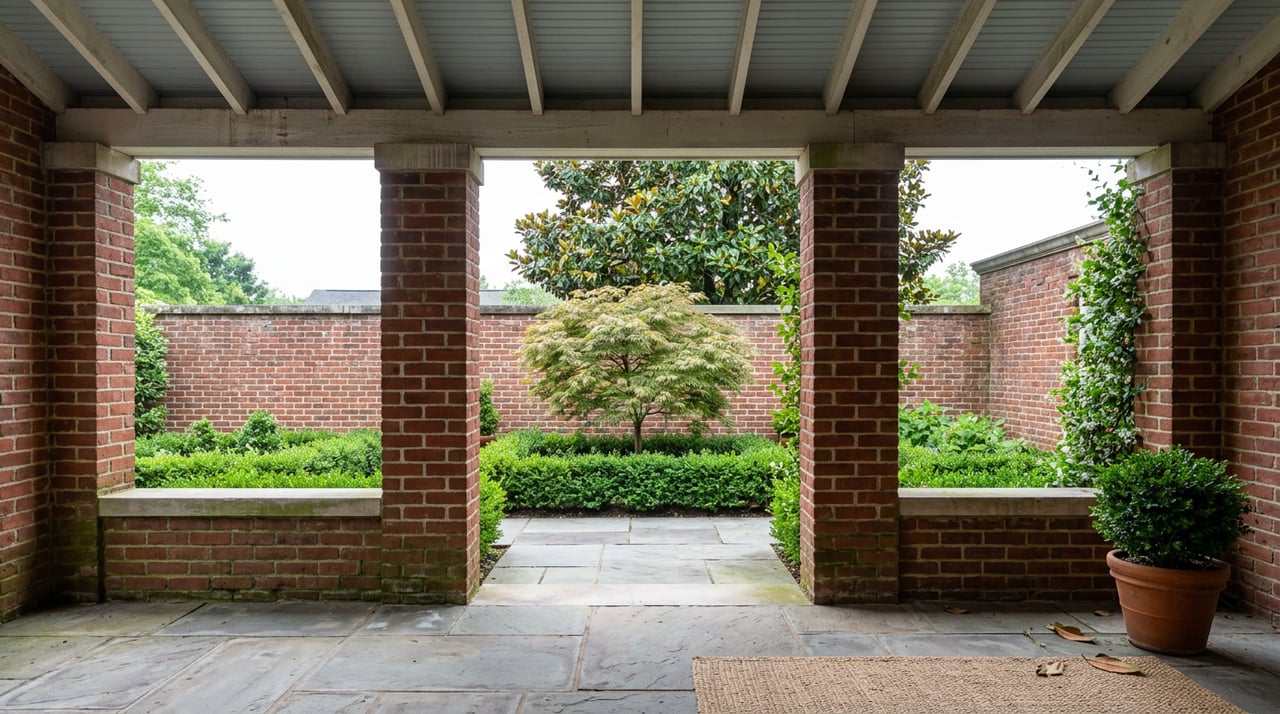
None of this history writing has slowed the neighborhood's physical growth. Hedgewood Homes built Delmont, a 32-home enclave inside Garden Hills, and by early 2025 nearly all of those homes had sold. The same developer followed with Sheridan, 13 additional homes designed by architect Lew Oliver and sited directly across from Atlanta International School. Sheridan's homes are built with private walled gardens, some with their own pools, and share Delmont's community saltwater pool and central plaza. Reporting from that period put pricing between roughly $1.4 million and just over $2 million.
Norman Davenport Askins, the architect who has lived in Garden Hills since the 1970s and keeps his office in the neighborhood too, described the trade-off residents make here in a conversation with Atlanta Homes & Lifestyles:
"It's like you live in a little country town, but everything in Buckhead is just minutes away."
That line was published before the centennial even started, but it holds up against everything that's happened since. A neighborhood can spend a year writing its own history, rebuilding its curbs, and still be adding new streets of houses in the same twelve months.
What Actually Marks a Hundred Years
Add it up and Garden Hills' centennial didn't end on a single night at Cherokee Town Club. The book landed months later. The clock is still to come. The sidewalks are being rebuilt by a city project that was never part of the anniversary to begin with. And through all of it, Hedgewood Homes kept building, Lew Oliver kept drawing walled gardens across from the international school, and the neighborhood's civic organizations kept tending to their own history, including the restored Bagley Park name.
A hundred years doesn't wrap up on the date somebody printed on an invitation. In Garden Hills, it's still showing up in pieces, on its own schedule, whether the calendar agrees or not.
If you're curious about how a neighborhood this specific keeps changing shape, block by block, Sonny Jones has been following Garden Hills closely and is glad to talk through what's actually happening on its streets. Request a private consultation.